
Archive Your Work
First published on the TYPESETT design blog website that was active around ~2010.
Archiving my past projects is something that I did not do well. It all somehow ends up in a box that I shove somewhere — and when I need it, I pray that it’s still in presentable shape. That’s quite pathetic on my part. However, I’ve changed my ways due to lack of space and anybody who has the same issues can learn from my recent archiving adventures. Here’s a simple five step guide to archiving your work reliably and efficiently:
1 — Keep Work That Has Lasting Value
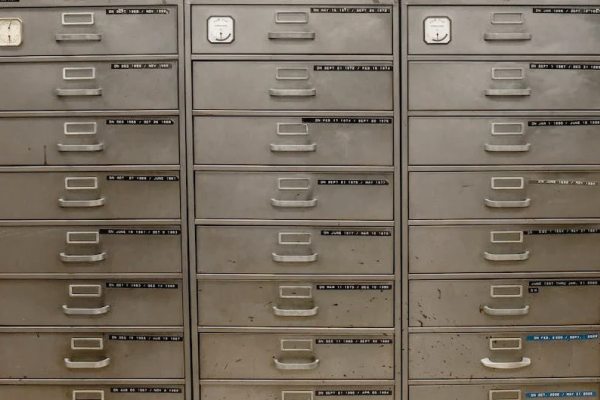
The meaning of “important” is different for everybody but if you want to keep an efficient archive where you can easily find your work, don’t be afraid to part ways with non-essentials. Many people believe that their archives serve as an overview of their work and careers. Does having three versions of the same postcard you designed at your first job really deserve a spot in your Hall of Fame?
Having said that, keep other items from that project that shed more light on the actual design process such as sketches, print-outs, client testimonials and Polaroids. For those iffy items whose fate you just can’t decide upon — scrap the physical version and make sure you have it on disk to make your heart feel a little better. Don’t worry, those postcards are in a better place and will live on in our hearts forever.
2 — Logically Group Your Work Together
This depends on what type of designer you are — whether you’re an in-house, freelance or design studio employee. When I was a in-house designer, I grouped everything by year and all I had to do was go to the year and the piece would usually be chronologically ordered (by stacking newest on oldest). Freelancers often group their projects by clients but under circumstances they like to group by type of project.
For example, my friend is a screen print designer and prefers to organize by apparel, paper medium and weird stuff like Frisbees. Now that I work in a studio atmosphere, I prefer to actually archive by year and type of project. So in the future, all I’d need to remember is the year and I should be able to find the type of project because they are grouped together (different than when I was in-house because grouping by client was more easier as their projects were similar in tone and subject matter). Do what makes most logical sense for your individual needs but year, client and category are good places to start.
3 — Store Your Work In Trusted Archive Quality Containers
There is no way around this one. You’ll need to get your mitts on suitable vessels for your work to ensure longevity. Go online and get yourself some acid and lignin-free archive safe folders, boxes, tubes and what have you. Paper is often treated with acid because it aids writing but over time it breaks down paper.
That can translate to making your work brittle and yellow. Lignins are a natural substance found in wood (and therefore paper) that breaks down over time to create acid… which means brittle and yellow once again. If you’re in a bind but want to archive on a budget, buy some acid-free paper and cut it up to buffer your most valued pieces while in storage. You can invest in some proper containment units when you have the means to do so.
4 — Label It
You scoff at this suggestion now but we’ll laugh last when you’re confronted with several seemingly identical boxes staring you in the face when you need it most. For all the all-star lazies out there — take some post-it notes, capture the year, client and project of as many pieces you can muster and slap it onto the inside box lid, tape it to the exterior of the tube or someplace easy to spot. That’s the minimum you need to achieve to have some semblance of find-ability later on. Hopefully, if you organized your work logically, you’ll be able to find work contextually despite not doing careful inventory.
For every one else, take the time to label the box with what’s inside and perhaps even devise a simple system you can document. For example, you can have 3 boxes labeled A, B and C. Each letter can represent a year, a range of clients or a category of projects. The first box (or whichever vessel is most accessible) can be accompanied by a documented key explaining how the system works. Anybody who has ever had to remotely ask a wife, parent, sibling or roommate to search for something while you are away will see the value in this step. The amount of work you put in towards labeling will directly correlate into how easy you can find things later on (especially as the archive grows).
5 — Store It Somewhere Safe Away From Sunlight & Water
Sunlight and water are the two arch enemies you must avoid at all costs. That means using your best judgment in keeping away from washing machines in the basement, anywhere near aquariums of any kind, a closet that has any appearance of water damage or anywhere else that has even a hint of danger.
If where you’re currently residing doesn’t offer a safe and hospitable environment for your archive think about leaving it in storage. Whether that be paid storage if you’re in a urban city like NYC or yo’ mama’s house if that’s an option for you. It’s a risk you don’t want to take because these items are often irreplaceable.
6 (Bonus) — Digital Archives?
Data media is cheap compared to the past, I keep my work on hard drives and back it up on DVD. Experts suggest that you keep equipment so that you can still access the old digital files but my personal preference is to export a high-res PDF and leave it at that (for closed projects and clients that are not coming back [thanks, Nick]). If I desperately needed something from an old project, a high-res PDF will suffice almost all of the time. I would not keep an old computer or a zip-drive around anymore for the sake of backwards compatibility and instead focus on transferring them to new technology.
Permalink: https://jacktse.com/archive-your-work/